Many agents, one job: orchestration and observability
Splitting a task across several agents can make it faster and more reliable, or much harder to debug. Four coordination patterns, and why a trace of every step is what makes them workable.
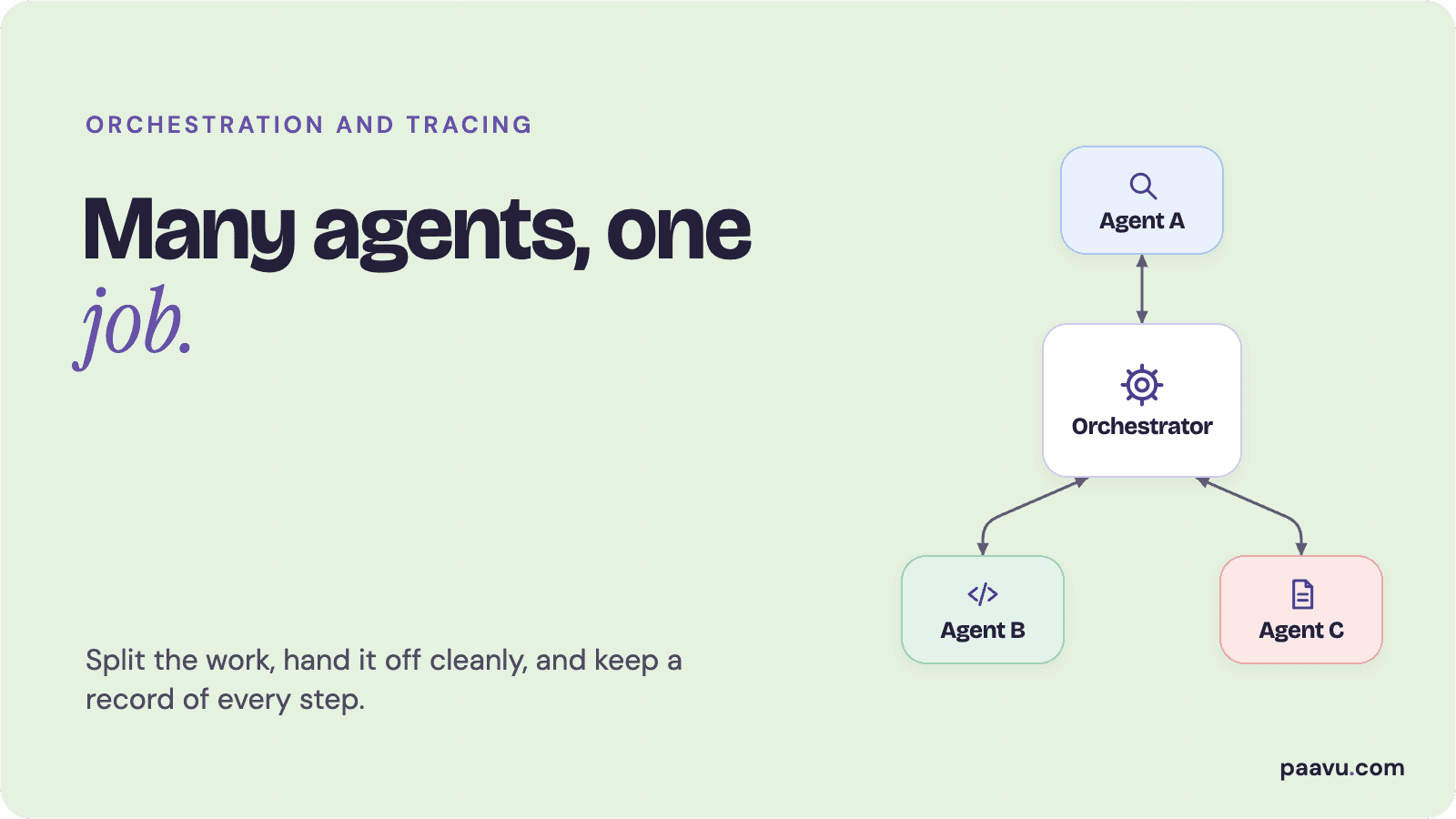
One agent with a long list of tools and instructions tends to get confused. The usual answer is to split the work: a few focused agents, each good at one thing, coordinated by something that knows the whole job. That works well when it is designed, and badly when it is improvised.
Four ways to coordinate
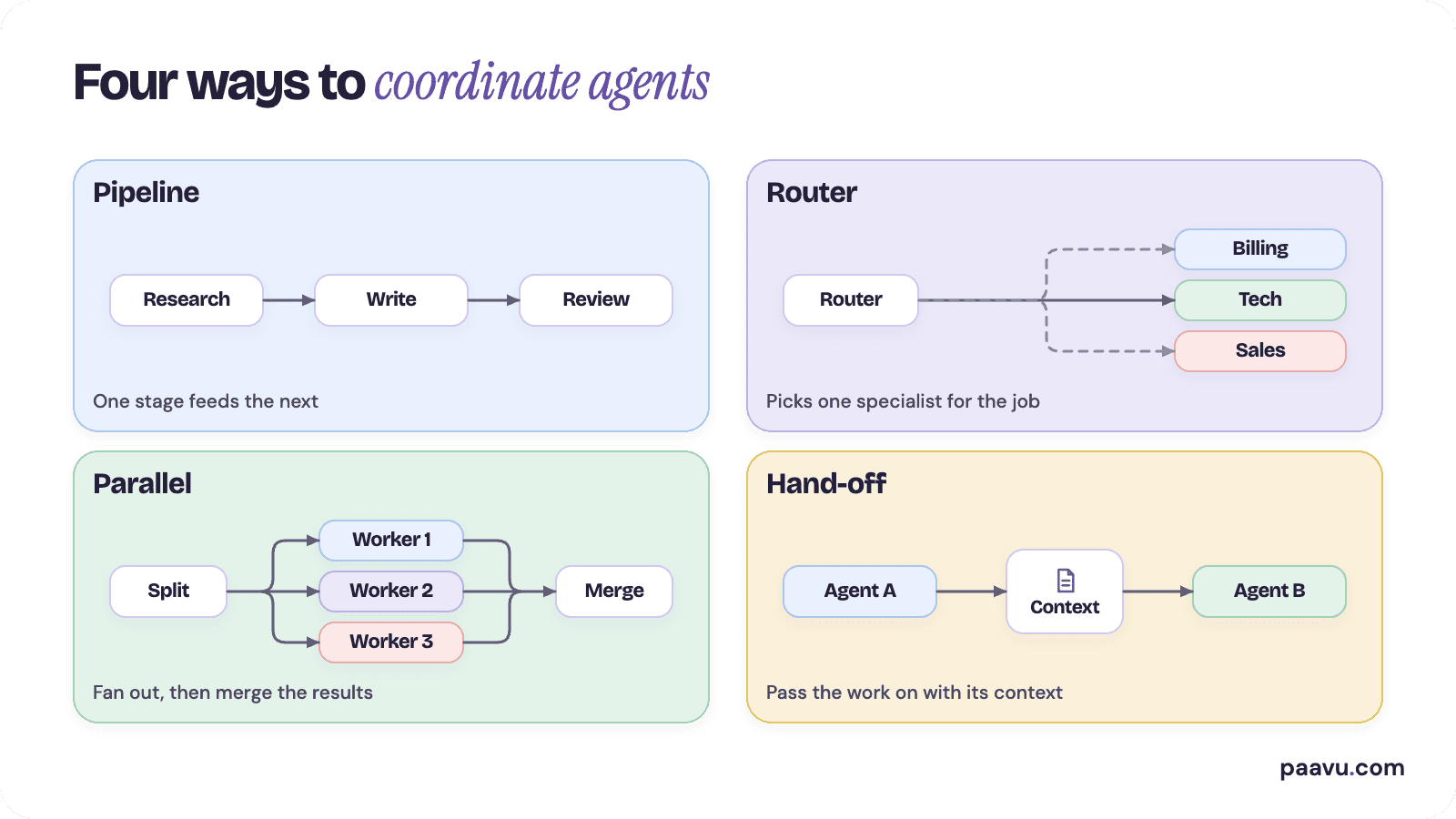
- Pipeline. One agent's output becomes the next one's input, in a fixed order. Simple and easy to follow, for example extract, then check, then summarise.
- Router. A first agent reads the request and sends it to the right specialist. Useful when requests vary a lot.
- Parallel. Independent agents work at the same time and a final step merges what they found. Good for research and review tasks.
- Hand-off. One agent passes the whole task, with the context it has gathered, to another that owns the next stage.
Start with the simplest pattern that fits. Every extra agent adds a place where information can be dropped or misread, so a pipeline of two beats a clever network of five.
Make the hand-offs explicit
Most multi-agent failures happen between agents, not inside them. Define what each agent receives and returns, in a fixed format, and check it. If an agent's answer is vague, the next one inherits the vagueness and adds its own.
Why you need a trace
When one agent fails you can read its output. When five agents pass work around, you cannot tell where it went wrong without a record. Observability means capturing every step: the request, the plan, each tool call with its inputs, outputs, time and cost, and the final answer.
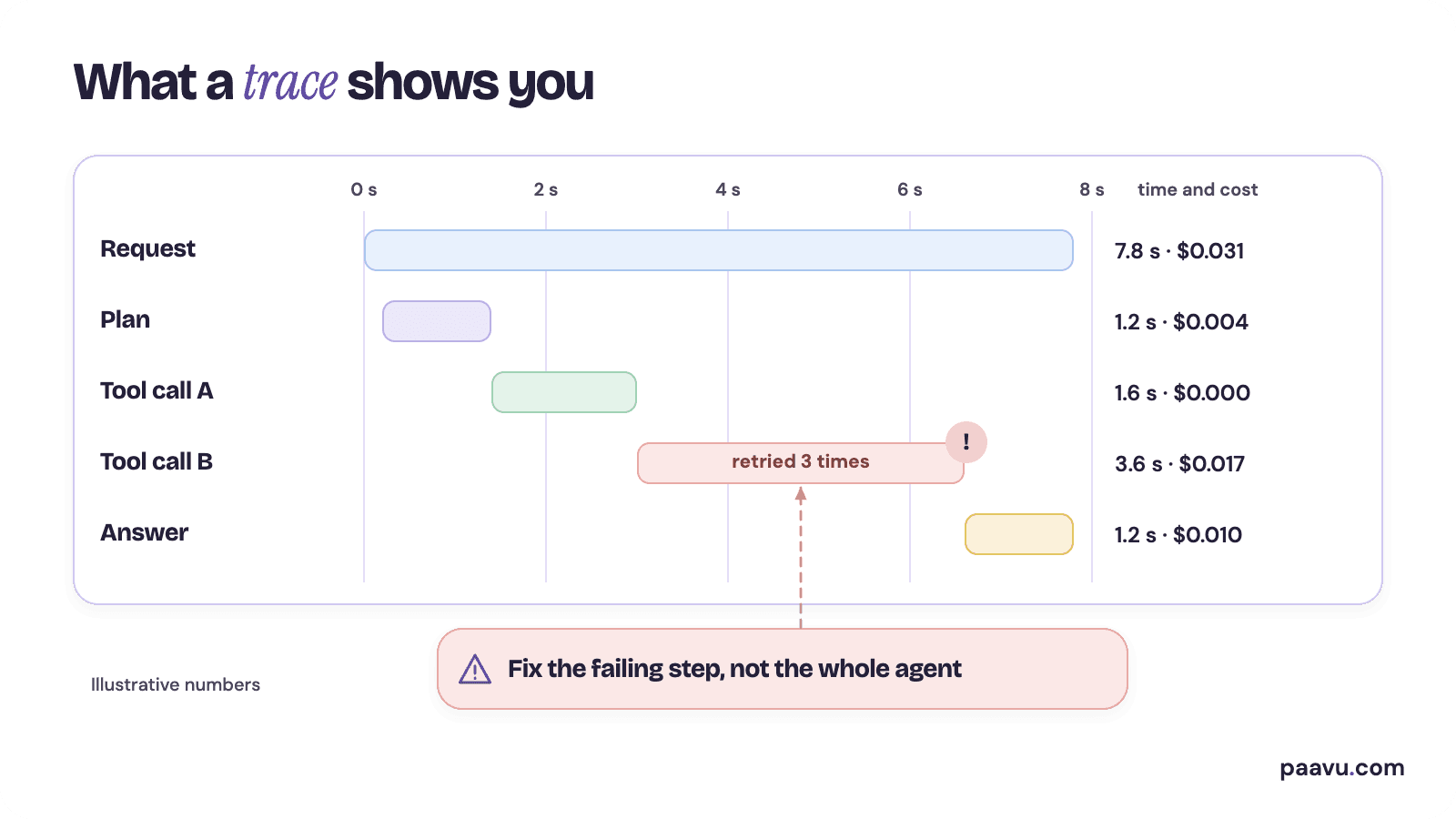
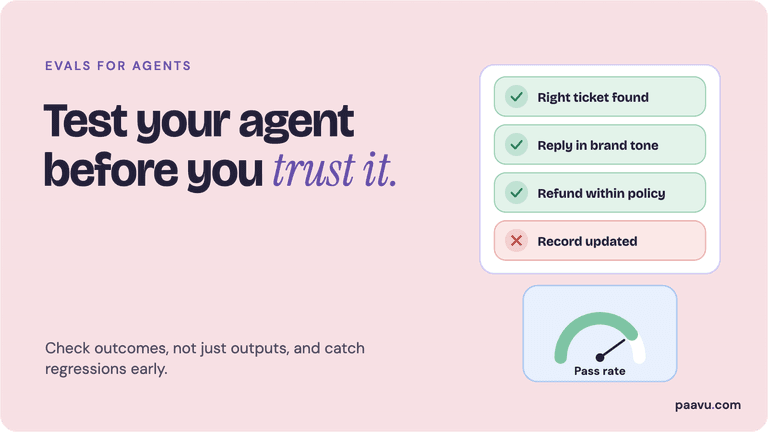
With that record you can fix the failing step instead of guessing, spot where cost is piling up, and show a customer exactly what happened. It also feeds your evals, because a real failure becomes a new test case.
Both of these depend on a solid base, which is covered in our post on the harness, and on knowing the whole map, which is in the ten skills overview.
If you want help with this on your own workflows, get in touch and we will look at it together.