The maths you actually need to work with AI
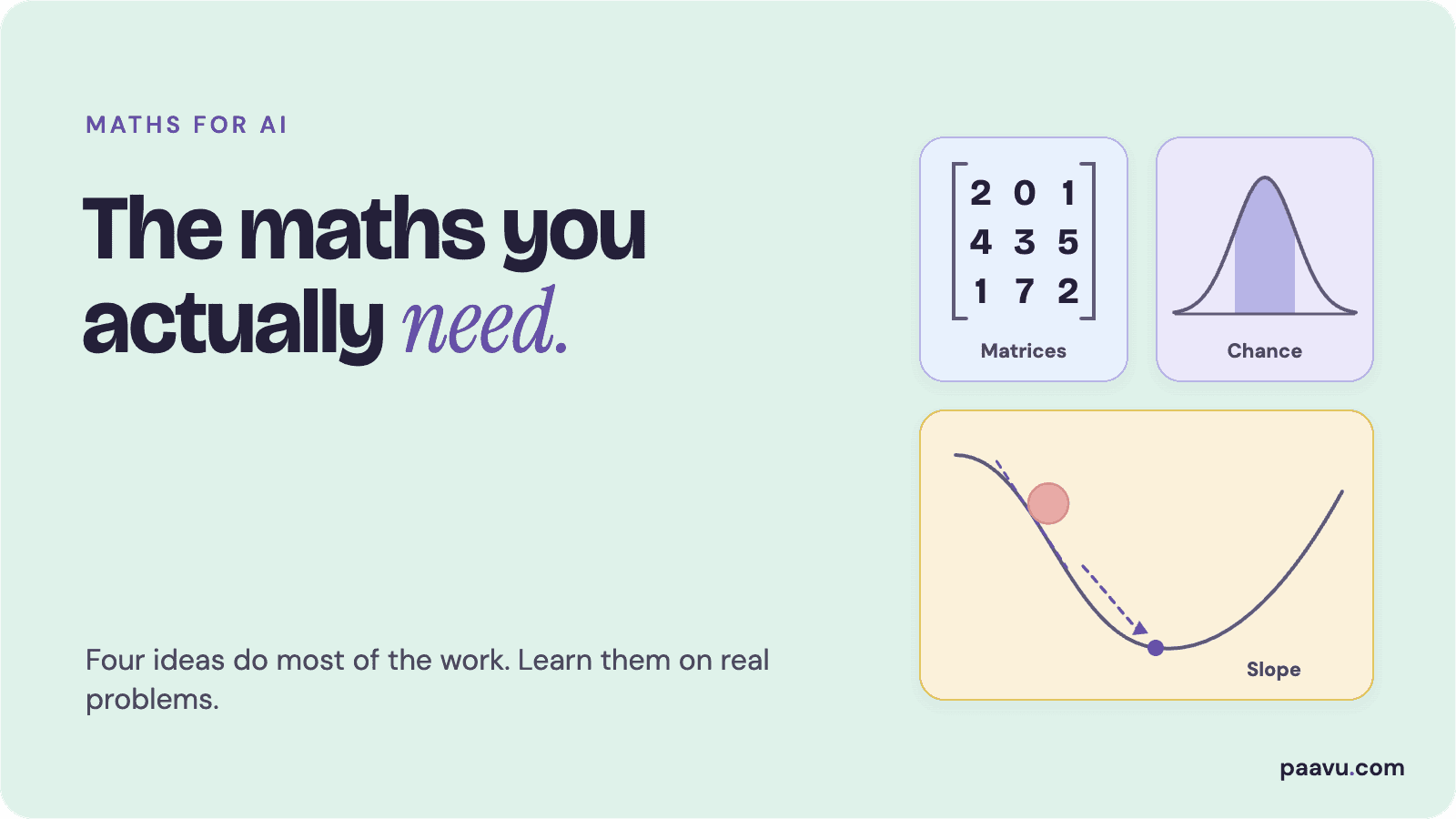
You do not need a semester of lectures. Four ideas, linear algebra, probability, calculus and estimation, cover most of what it takes to follow what AI is doing, and they are best learned by using them.
Every few months someone tells you that to keep up with AI you need to go back and learn maths properly. Calculus, linear algebra, statistics, the lot. It sounds like a semester of lectures, and most people quietly decide to skip it.
The good news is that the amount you need is smaller than the syllabus suggests, and the way to learn it is different from how school taught it.
Maths is a toolkit, not a monument
School tends to present maths as finished truth handed down from above. In reality it grew out of people trying to solve practical problems, such as navigating by the stars, pricing risk or predicting tides. That matters, because it means you can learn it the same way: start with the problem and pick up the tool you need.
For working with AI, four ideas do most of the work.
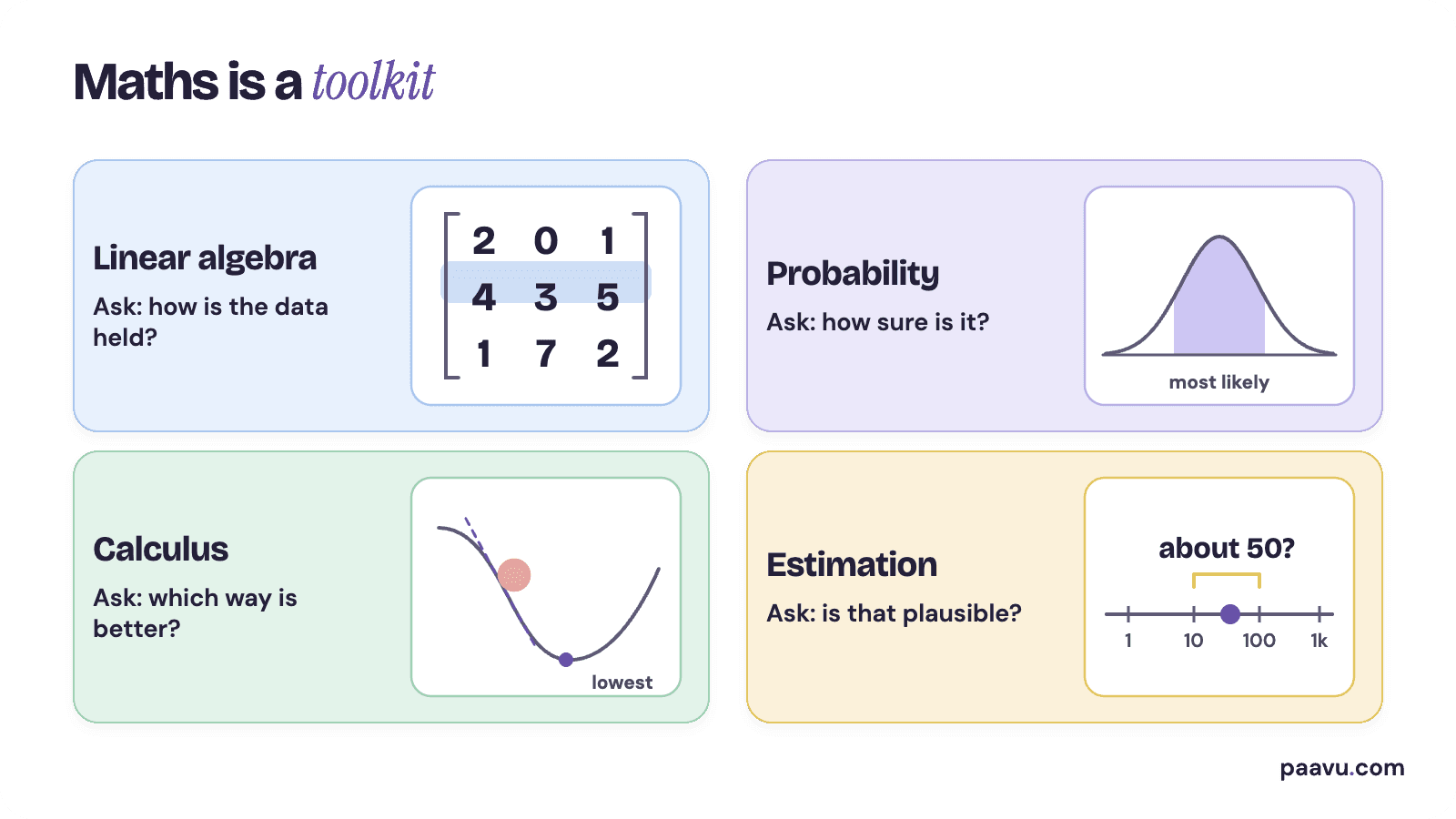
1. Linear algebra: how models hold data
A model never sees a sentence or a photo. It sees lists and grids of numbers, and everything it does is combining those grids. You do not need to prove theorems. You need to be comfortable with what a vector and a matrix are, and what it means to multiply them. Once that clicks, embeddings, attention and "dimensions" stop sounding like jargon.
2. Probability: how models guess
Language models predict what is likely to come next, and classifiers output a confidence, not a certainty. Reading those numbers well means understanding likelihood, base rates and how new evidence should change your belief. This is also the idea that protects you from a convincing but wrong output.
3. Calculus: how models learn
Training is repeated nudging. Compute how wrong the model is, work out which direction would make it less wrong, and take a small step that way. That direction is a gradient. You can understand the whole loop without solving a single integral.
4. Estimation: the habit that catches nonsense
Rough sizing is the least glamorous skill and the most useful. How many documents is that, how many tokens, what will it cost per month, how large could the error be? A quick estimate tells you when a claim or a budget cannot be right.
A way to learn it that sticks
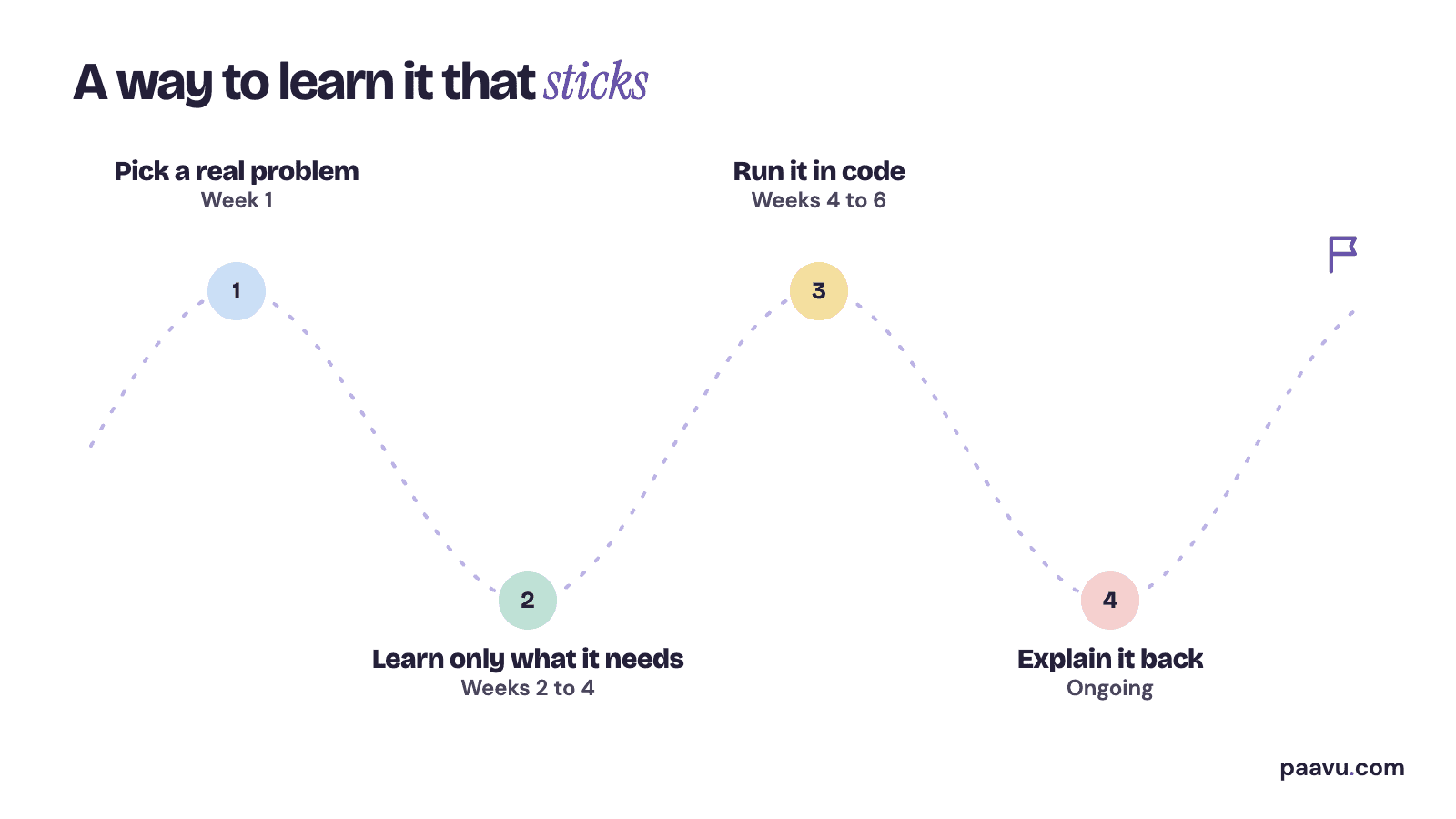
- Pick a real problem. Choose something from your own work, such as forecasting orders or sorting support tickets.
- Learn only what it needs. Meet each idea at the moment you need it, not months in advance.
- Run it in code. A small notebook where you change a number and watch the result beats a page of notation.
- Explain it back. If you can tell a colleague why the model got something wrong, you have understood it.
What this means for your team
You do not need everyone to become a mathematician. You need a few people who can read a metric critically, ask how sure a model is, and notice when a number does not add up. That is a skill you can build in weeks, and it pays back every time you evaluate a tool or a vendor claim.
If you want help building that confidence across a team, through workshops built around your own data and workflows, get in touch.
This post was inspired by Jose Crespo, PhD and his article The Maths You Need to Survive AI, and Nobody's Teaching You, which makes the case for learning maths as a practical toolkit.